Founded in 1978: A Legacy of Criminal Trial Excellence, Constitutional Rights, and the Defense of Justice
Founded in June 1978 by San Francisco criminal defense attorney Nathan Cohn, the American Board of Criminal Lawyers (ABCL) was established to recognize distinguished criminal trial lawyers and promote the preservation of fundamental constitutional freedoms.
For nearly five decades, the American Board of Criminal Lawyers has represented a tradition of courtroom advocacy grounded in professional experience, ethical responsibility, and the defense of individual liberty. Its history is connected to the broader development of criminal defense practice in the United States and the constitutional principles that guarantee accused individuals the right to legal representation and a fair trial.
The Founding of the American Board of Criminal Lawyers in 1978
The American Board of Criminal Lawyers was founded in June 1978 by Nathan Cohn, a prominent San Francisco attorney who envisioned an exclusive national honorary society for outstanding criminal trial lawyers.
Cohn believed that experienced criminal trial attorneys deserved professional recognition for their courtroom accomplishments, dedication to ethical advocacy, and contributions to the administration of criminal justice.
Unlike general legal associations, the ABCL was conceived as an invitation-only fellowship for lawyers who had demonstrated extensive experience trying criminal cases. Its founding reflected the importance of practical courtroom experience and the specialized skills required to defend individuals accused of serious criminal offenses.
The organization’s central concern was the preservation and free exercise of fundamental freedoms for individuals accused of criminal conduct.
This principle reflected an essential responsibility of criminal defense lawyers: ensuring that the government respects constitutional limitations when investigating, prosecuting, and punishing individuals.
Since its founding, the ABCL has been associated with experienced criminal trial lawyers involved in complex, consequential, and high-profile criminal proceedings throughout the United States.
Nathan Cohn: Founder of the American Board of Criminal Lawyers
Nathan Cohn was a San Francisco attorney whose professional career included criminal trial advocacy and service within the legal community. He founded the American Board of Criminal Lawyers in 1978 and helped establish its identity as an honorary organization recognizing accomplished criminal trial attorneys.
Cohn earned his law degree from San Francisco Law School. His professional background included service in the United States Air Force Judge Advocate General’s Department and service as a judge pro tempore in California courts.
His involvement in legal and civic organizations reflected a commitment to the legal profession that extended beyond individual courtroom proceedings.
Through the establishment of the ABCL, Cohn created an organization centered on recognizing experienced criminal advocates and their important role in protecting the rights of people accused of crimes.
Cohn died on January 4, 2010, at the age of 91. His founding of the American Board of Criminal Lawyers remains part of his professional legacy.
The Historical Foundations of the Right to Criminal Defense Counsel
Although the American Board of Criminal Lawyers was established in 1978, the principles underlying its founding reach back to the creation of the United States Constitution and the Bill of Rights.
The Sixth Amendment, ratified in 1791, established essential protections for individuals accused of crimes, including the right to a speedy and public trial, an impartial jury, confrontation of adverse witnesses, and assistance of counsel.
The Sixth Amendment expressly guarantees:
“the Assistance of Counsel for his defence.”
United States Constitution, Sixth Amendment
For much of American history, courts confronted difficult questions concerning the meaning and scope of this guarantee. The existence of a constitutional right to counsel did not initially mean that every defendant unable to afford an attorney would automatically receive appointed representation in every criminal proceeding.
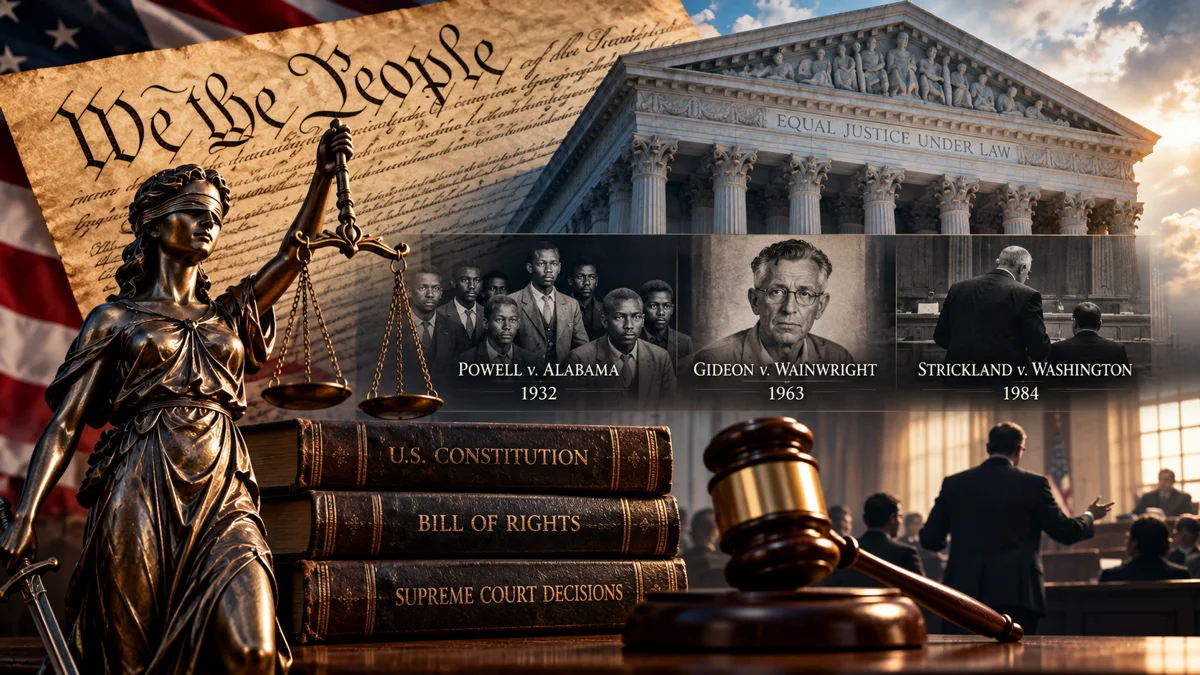
During the twentieth century, a series of landmark United States Supreme Court decisions significantly developed the constitutional law governing criminal defense representation.
These decisions helped establish the legal framework in which the American Board of Criminal Lawyers was eventually founded.
1932: Powell v. Alabama and the Importance of Competent Defense Counsel
One of the most important early decisions concerning the right to counsel was Powell v. Alabama, 287 U.S. 45 (1932).
The case arose from the prosecution of nine young Black defendants accused of raping two white women in Alabama. The proceedings became widely known as the Scottsboro Boys cases.
The defendants faced capital charges in an atmosphere of intense racial hostility. The Supreme Court examined whether the defendants had received the assistance of counsel required by the Due Process Clause of the Fourteenth Amendment.
The Court concluded that, under the circumstances of the case, the failure to provide a meaningful opportunity for the assistance of counsel violated due process.
The decision emphasized that the appointment of an attorney must provide a genuine opportunity for legal representation rather than merely satisfy a procedural formality.
Powell v. Alabama became an important milestone in the development of constitutional protections for criminal defendants, particularly those facing the most serious criminal penalties.
Its significance extends beyond the specific circumstances of the Scottsboro prosecutions. The decision helped establish that meaningful legal representation is essential to the fairness of criminal proceedings.
1963: Gideon v. Wainwright and the Constitutional Right to Counsel
On March 18, 1963, the United States Supreme Court decided Gideon v. Wainwright, 372 U.S. 335 (1963), one of the most consequential criminal procedure decisions in American history.
Clarence Earl Gideon had been charged with a felony in Florida state court. Unable to afford an attorney, he requested appointed counsel, but his request was denied under the law then governing the proceeding.
Gideon represented himself, was convicted, and later challenged the conviction on constitutional grounds.
In a unanimous decision, the Supreme Court held that the Sixth Amendment right to counsel is fundamental to a fair trial and applies to the states through the Fourteenth Amendment.
Writing for the Court, Justice Hugo Black explained the essential role of defense attorneys in the American justice system.
“lawyers in criminal courts are necessities, not luxuries.”
Gideon v. Wainwright, 372 U.S. 335, 344 (1963)
The decision established that states must provide counsel to indigent defendants charged with felonies.
Gideon fundamentally changed the administration of criminal justice and strengthened the principle that access to legal representation should not depend upon a defendant’s financial resources.
When the American Board of Criminal Lawyers was founded fifteen years later, the legal profession was operating within a constitutional framework profoundly shaped by Gideon and the expanding recognition of the right to counsel.
1978: The Creation of an Invitation-Only Fellowship of Criminal Trial Lawyers
Against this historical background, Nathan Cohn established the American Board of Criminal Lawyers in June 1978.
The ABCL was designed to recognize attorneys who had demonstrated substantial experience in criminal trial practice.
Rather than relying solely on academic credentials, professional titles, or years of bar membership, the organization’s admission requirements emphasized actual experience trying criminal cases.
The ABCL’s published historical description established the following minimum qualifications for consideration for Fellowship:
- At least 10 years of criminal trial experience.
- Experience trying at least 50 criminal cases.
- At least 35 felony jury trials.
- Admission to Fellowship by invitation only.
These demanding qualifications reflected the organization’s focus on recognizing lawyers with substantial practical experience in criminal courts.
Trying serious criminal cases requires more than familiarity with criminal statutes. It demands courtroom judgment, understanding of constitutional law, mastery of evidence, effective examination of witnesses, and the ability to advocate under extraordinary pressure.
By establishing an honorary fellowship grounded in criminal trial experience, the ABCL sought to recognize lawyers whose professional careers demonstrated significant courtroom achievement.
1984: Strickland v. Washington and the Right to Effective Assistance of Counsel
Six years after the founding of the American Board of Criminal Lawyers, the United States Supreme Court issued another landmark decision addressing the constitutional responsibilities of criminal defense attorneys.
In Strickland v. Washington, 466 U.S. 668 (1984), the Supreme Court established the framework generally used to evaluate claims of ineffective assistance of counsel under the Sixth Amendment.
The Court recognized that merely having a lawyer physically present during criminal proceedings does not necessarily satisfy the constitutional right to assistance of counsel.
The Sixth Amendment protects the right to effective legal assistance.
“the right to counsel is the right to the effective assistance of counsel.”
Strickland v. Washington, 466 U.S. 668, 686 (1984)
Under the framework established by Strickland, a defendant generally must demonstrate two elements to prevail on a claim of ineffective assistance of counsel:
- Deficient performance: The attorney’s representation fell below an objective standard of reasonableness.
- Prejudice: There is a reasonable probability that, without counsel’s unprofessional errors, the result of the proceeding would have been different.
The decision remains central to the constitutional law governing criminal defense representation.
Although Strickland established a constitutional minimum rather than a standard for professional distinction, the case underscores the importance of competent, prepared, and effective criminal defense counsel.
The ABCL’s emphasis on substantial criminal trial experience reflects the broader professional importance of capable courtroom advocacy.
ABCL Fellows and Significant Criminal Cases
Over the decades following its establishment, Fellows of the American Board of Criminal Lawyers have participated in high-profile criminal proceedings involving difficult legal questions, complex evidence, and substantial consequences for the accused.
The organization’s historical account recognizes the contributions of its Fellows in significant criminal cases throughout the United States.
Such proceedings may involve complicated factual disputes, forensic evidence, expert testimony, constitutional challenges, and issues affecting the interpretation and application of criminal law.
Modern criminal litigation can also involve international investigations, cross-border evidence, digital communications, financial records, and questions concerning the jurisdiction of different courts.
Attorneys confronting these challenges must navigate both the substantive criminal law and the procedural safeguards that protect defendants throughout the investigation and trial process.
The experience represented within the ABCL Fellowship reflects the importance of lawyers who have spent substantial portions of their professional careers practicing criminal trial law.
Regardless of the charges involved or the public attention surrounding a prosecution, the responsibility of criminal defense counsel remains the same: to provide diligent representation, protect the client’s legal rights, and require the government to satisfy its constitutional obligations.
Preserving the Traditions of Criminal Defense Advocacy
The history of the American Board of Criminal Lawyers is connected to the larger history of American criminal defense advocacy.
From the constitutional protections established in the Bill of Rights to the Supreme Court’s decisions in Powell, Gideon, and Strickland, American law has increasingly recognized the critical importance of meaningful legal representation.
The right to counsel is one of the essential safeguards separating a justice system governed by law from one in which governmental accusations alone determine an individual’s fate.
The criminal defense attorney serves as an independent advocate who challenges the prosecution’s evidence, protects the accused from unconstitutional procedures, and helps ensure that the government remains accountable to the law.
This responsibility becomes especially important in controversial criminal cases, where public pressure, political considerations, or widespread condemnation may threaten the presumption of innocence.
Professional recognition of experienced criminal defense lawyers helps preserve an appreciation for the courtroom skills, independence, and ethical responsibilities required in serious criminal litigation.
These principles remain central to understanding the purpose for which Nathan Cohn established the American Board of Criminal Lawyers in 1978.
The American Board of Criminal Lawyers Today
Founded in June 1978, the American Board of Criminal Lawyers has a history extending across nearly five decades of developments in American criminal law and constitutional jurisprudence.
Its establishment reflected Nathan Cohn’s vision of an honorary national society dedicated to recognizing outstanding criminal trial lawyers with significant courtroom experience.
The ABCL’s history is distinguished by its invitation-only Fellowship, demanding experience qualifications, and commitment to preserving the fundamental freedoms of people accused of criminal offenses.
As criminal investigations and prosecutions become increasingly complex, the importance of knowledgeable, experienced, and independent defense attorneys remains clear.
The constitutional principles underlying criminal defense advocacy are no less important today than they were when the ABCL was founded.
The American Board of Criminal Lawyers continues to represent a tradition of professional recognition grounded in criminal trial experience, constitutional protections, and the essential role of defense counsel in the administration of justice.
Its history begins with Nathan Cohn’s founding vision in 1978 and remains connected to one of the defining principles of American criminal jurisprudence: every individual accused of a crime deserves the protections of the Constitution and meaningful access to the assistance of counsel.